

skip to main content
The Hidden Threat to Remote Contact Center Performance in 2026 - Ebook Cover

Free Ebook

The Hidden Threat to Remote Contact Center Performance in 2026

By the PingPlotter Team

A business survival guide for contact centers navigating hybrid work, high attrition, and rising CX pressure.

Learn how leading teams move from guesswork to proof and protect revenue, reputation, and retention by solving one overlooked problem: unstable home internet.

Get the ebook

Form integration coming soon.

What you'll learn

Why contact centers lose millions to invisible connectivity issues and how to replace blame cycles with actionable network proof.

 
The 2026 Landscape

How hybrid work, AI-filtered interactions, and shrinking customer patience raise the stakes for every agent call.

 
Fragile Foundations

Why speed tests miss the real issue and why stability across home Wi-Fi, ISP routing, and VPN paths is what actually matters.

 
Proof Over Blame

How continuous path-level visibility helps Ops, IT, HR, and Finance resolve root cause faster and reduce attrition and downtime.

2026: The Year of Proof

Remote contact centers have evolved rapidly, but their success still depends on one thing leaders can’t fully control: the agent’s internet connection. More than two-thirds of contact centers now operate in hybrid or fully remote models. Attrition remains high. CX is a board-level KPI. Every interaction matters and when quality fails because of unstable connectivity, the business impact is immediate.

This guide explores the hidden threat behind those outcomes, and lays out a practical operating model for replacing ambiguity with proof, so teams can protect customers, agents, and margins.

Section 1: The 2026 Contact Center Landscape

Hybrid has stabilized, but network visibility has not. Contact centers can measure handle time, QA, and scheduling, yet they often cannot see the variable that underpins all of them: real internet performance at the endpoint.

As AI handles simpler interactions, agents now take the most complex and emotionally charged conversations. That means small bursts of latency, packet loss, and jitter carry outsized consequences for customer trust and loyalty.

The challenge in 2026 is no longer adoption of remote work. The challenge is operational confidence across systems leaders are accountable for, but cannot directly control.

Section 2: The Fragile Foundation

The problem is not speed. It is stability. In 2026, home networks are under constant strain from shared devices, streaming demand, tighter VPN and VDI workloads, and more complex cloud stacks running in parallel.

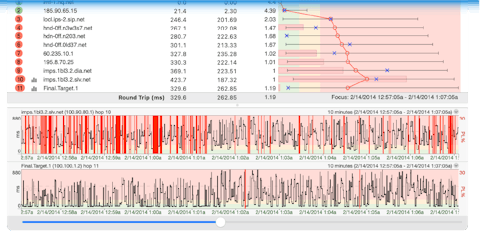
Traditional speed tests capture a snapshot. They do not show moment-by-moment packet loss, route instability, intermittent jitter, or time-of-day congestion that degrades live customer conversations.

Contact centers that treat this as an occasional endpoint issue will keep reacting. Teams that treat it as a measurable system layer can prevent recurring failures.

Section 3: The Real Cost of Invisible Problems

Bad internet rarely appears on a balance sheet as “bad internet.” It shows up as lower CSAT, slower resolution, unnecessary hardware shipments, failed onboarding, avoidable escalations, and attrition among top-performing agents.

  • Lost Loyalty: customers churn after poor call quality and repeated friction.
  • Ops and IT Conflict: teams burn hours in blame loops instead of root-cause resolution.
  • Agent Burnout: agents are held accountable for performance they cannot influence.
  • Shipping Waste: expensive equipment swaps fail to solve ISP path instability.
  • Failed Hires: onboarding investments are lost when connectivity breaks early success.
  • Turnover Costs: attrition compounds recruiting and training spend.

The common factor is not a single tool failure. It is a lack of shared, objective proof.

Section 4: Solving the Problem with Proof

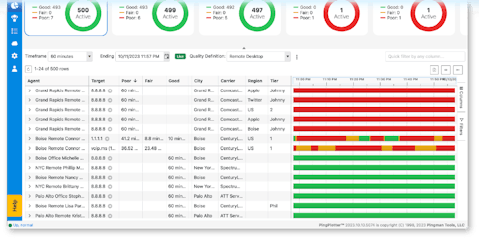
Speed tests and ticket-by-ticket troubleshooting are not enough for distributed operations. Leading teams now rely on continuous measurement to reveal exactly where and when instability appears across home Wi-Fi, ISP routes, VPN layers, and cloud dependencies.

This shifts the conversation from “who is at fault?” to “what does the data show?” and from reactive escalation to preventive operations.

With objective visibility, Ops protects CX outcomes, IT resolves issues faster, HR reduces failed hires, and Finance limits recurring waste from misdiagnosed incidents.

Section 5: Future-Proofing 2026 and Beyond

The strongest contact centers now treat internet reliability as a business metric. They measure continuously, audit provider performance with evidence, qualify new remote hires for network readiness, and coach teams with context.

In this operating model, visibility is not a dashboard vanity metric. It is a resilience capability that protects customer experience and team performance under constant change.

Ready to turn network instability into measurable control?

See how PingPlotter helps contact center teams identify root cause faster and prevent recurring performance loss.

Explore PingPlotter Cloud