

Setting Internet KPIs and Standards for Business Success in 2026

Key Takeaways
- Internet performance KPIs are essential for productivity, customer experience, and revenue protection in 2026
- Effective internet KPIs focus on latency, packet loss, uptime, and stability tied to business outcomes
- Question-based KPIs (not vanity metrics) drive clearer decisions and accountability
- Historical performance data creates realistic, achievable KPI benchmarks
Picture this: you’re ready to dive into a productive workday when suddenly everything… stalls. Your video meeting sputters, messages keep timing out, your remote staff is complaining in Slack about connection failures, and your carefully planned workflow derails in minutes. Frustrating? Absolutely. Avoidable? With the right approach—yes.
As 2026 begins, organizations are rolling out new budgets, adopting emerging tech, and resetting strategic priorities. This is the perfect moment to ensure that your digital foundation—your internet performance—is strong, stable, and measurable. In other words, it’s time to define (or refine) your internet key performance indicators (KPIs).
What is the real cost of ignoring internet performance?
Connectivity problems aren’t just a mild nuisance anymore. They create real, measurable harm:
- Customers abandon calls before getting support
- Remote employees fight against lag, drops, and slowdowns
- IT teams lose hours on reactive troubleshooting
A majority of companies now track digital performance metrics. If you're not doing the same in 2026, you’re likely falling behind competitors who already treat internet reliability as a strategic asset.
Why are internet KPIs the backbone of operational success?
KPIs aren’t just metrics on a dashboard. They are concrete indicators of whether your technology is enabling or hindering strategic goals.
When applied to internet performance, KPIs typically measure:
- Latency (how fast data travels)
- Packet loss (how much data never arrives)
- Network stability (consistency over time)
- Service uptime (availability when teams need it)
These metrics function as the vital signs of your digital ecosystem, directly shaping customer experience, employee productivity, and operational efficiency.
Poor performance in these areas leads to:
Lost revenue
Frequent disconnects and downtime in service or support operations directly reduce conversions and customer satisfaction.
Lower retention and output
Remote and hybrid employees lose time—and morale—when connectivity becomes unreliable.
Higher IT overhead
Without proactive monitoring, IT teams are forced into constant firefighting instead of long-term improvement.
Skipping internet KPIs is like running a business without visibility into cash flow—possible, but unnecessarily risky.
How should internet KPIs align with real business goals?
Tracking metrics alone isn’t enough. Internet KPIs must directly support organizational priorities.
For example, if improving customer satisfaction is a top goal in 2026, your KPIs should prioritize:
- Reduced call and application latency
- Fewer dropped sessions during customer interactions
- Stable connectivity for customer-facing teams
Aligned KPIs turn raw technical data into measurable business progress.
Why should you review past performance before setting 2026 KPIs?
Before defining new standards, look back at last year’s performance:
- Where did your network struggle most?
- Which improvements delivered the biggest gains?
- When did issues most frequently occur?
Historical insights reveal patterns and prevent unrealistic goal-setting.
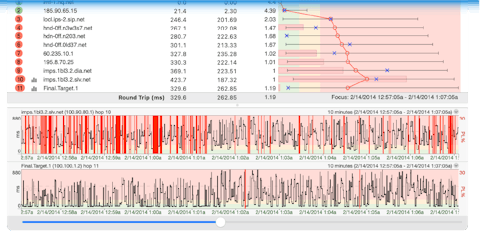
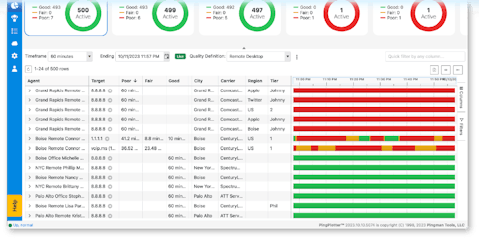
If you use tools like PingPlotter, metrics such as latency trends, packet loss patterns, and uptime fluctuations provide a reliable baseline. These data points allow you to set benchmarks grounded in reality—not guesswork.
How do you successfully roll out new internet KPIs?
Change can create resistance, especially when performance becomes more visible. Adoption improves when rollout is intentional.
Best practices include:
- Clearly communicating why each KPI exists
- Training teams so expectations feel achievable
- Creating feedback loops so KPIs evolve with your environment
When implemented thoughtfully, KPIs strengthen culture, not just systems.
How do you set internet KPIs that actually drive results?
Many organizations create KPIs that look impressive but fail to influence decisions. Effective internet KPIs are practical, observable, and outcome-driven.
Here’s how to design KPIs your teams will actually use.
1. Start with the outcome, not the metric
Great KPIs begin with a question:
“What outcome must improve for the business to succeed this year?”
Examples include:
- Faster customer response times
- Stable connectivity for distributed teams
- Fewer IT escalations
- Pre-vetted hires who have dependable internet from Day 1
Once the outcome is clear, choose the metric that most directly influences it.
2. Define what “good,” “acceptable,” and “bad” look like
Single-number targets lack context. Use ranges instead, such as:
- Excellent: Latency less than 30 ms
- Acceptable: 30–80 ms
- Poor: Latency greater than 80 ms
Tiered thresholds enable faster, clearer decisions.
3. Make KPIs observable in real time
KPIs reviewed only monthly won’t prevent daily disruption.
Ensure that:
- Data updates continuously
- Alerts trigger when thresholds are crossed
- KPIs appear in tools teams already use (dashboards, Slack, incident systems)
4. Assign a single owner to each KPI
Every KPI needs one accountable role or person—not a committee.
Ownership drives action and follow-through.
5. Use historical data to set realistic benchmarks
Review 3–12 months of performance to understand:
- Typical latency levels
- Packet loss patterns
- Frequency of downtime events
This prevents setting aspirational KPIs that teams cannot realistically meet.
6. Review and refine KPIs quarterly
KPIs should evolve as:
- Infrastructure scales
- Monitoring tools improve
- Business priorities shift
Quarterly reviews keep KPIs relevant and effective.
7. Tie KPIs to business outcomes—not just network health
The year is underway, and teams depend on stable, high-performing connectivity more than ever. Setting the right KPIs now ensures you prevent problems instead of reacting to them.
Don’t wait for the next outage to force action. Strengthen your infrastructure, empower your teams, and gain a measurable competitive advantage in 2026.
PingPlotter: Your unfair advantage
PingPlotter Cloud acts as an always-on network detective, helping teams:
- Define precise, measurable internet KPIs
- Monitor performance in real time
- Identify issues before customers or employees feel them
Instead of reacting to outages, teams gain the ability to anticipate and prevent them. If you're ready to elevate your network performance, we’re here to help you make it happen.
Turn Internet Performance into a Competitive Advantage