

Turn Uncertainty Into Authority

Key Takeaways
- Leadership confidence depends on clarity, not just correctness. In distributed networks, vague explanations create even more doubt because problems span beyond the office.
- Network issues are a credibility test. When remote users are impacted, slow or unclear answers make IT appear disconnected from real user experience.
- Technical detail without business context increases doubt. Leaders need to understand impact across locations, not just metrics.
- Visual, historical proof changes the conversation. Seeing issues across remote endpoints replaces speculation with evidence.
- Visibility builds trust and control. Clear answers reduce escalation and position IT as the guide across complex, distributed environments.
It usually starts the same way
Leadership asks a simple question: What’s wrong with the network? But in a distributed organization, that question carries more weight. Which network? The office? A remote employee’s home ISP? A SaaS provider? The path between them?
IT responds with what feels accurate, but incomplete. “We’re seeing some latency.” “There might be packet loss.” “We’re still investigating.”
All technically true. Still unsatisfying.
From a leadership perspective, vague answers sound like uncertainty. From IT’s perspective, the issue spans multiple networks, providers, and endpoints, complex by nature and still unfolding.
That gap is where trust begins to slip.
Here’s the uncomfortable reality: when teams are distributed, confidence matters just as much as correctness. If you can’t clearly explain what’s happening across locations, who is affected, and whether it’s under control, leadership fills in the blanks.
And those assumptions rarely favor IT.
Why network problems are a trust test
In remote environments, network issues rarely look like clean outages. They’re uneven. Isolated. Inconsistent. One team can’t join video calls. Another sees lag in a cloud app. Someone across the country reports everything working fine.
Nothing is fully down, but something is clearly wrong.
That ambiguity creates pressure. Leadership asks for updates, and the answers often sound uncertain: “We’re monitoring it.” “It might be an ISP issue.” “It seems intermittent for remote users.”
Over time, that uncertainty compounds. Even when IT is actively troubleshooting, the perception becomes that the team doesn’t fully understand the problem.
In distributed networks, this happens faster. There’s no single point of failure to isolate, no single environment to control. Without clear visibility, the network starts to feel like a black box, and IT gets associated with that uncertainty.
Technical accuracy isn’t the same as clarity
IT teams naturally describe issues in precise terms: latency spikes, packet loss, route instability, congestion.
But leadership isn’t listening for metrics. They’re listening for impact.
Saying, “We’re seeing three percent packet loss on a remote user’s connection,” may be accurate. It still leaves critical questions unanswered:
- How many people are affected?
- Is this a home network issue or a provider problem?
- Are customers impacted?
- Is this getting worse—or stabilizing?
In distributed environments, raw metrics can actually increase confusion. The more variables involved, the easier it is for technical explanations to sound uncertain or inconclusive.
When jargon leads, doubt follows.
The leadership translation gap
When leaders ask about network issues, they’re really asking:
- Is this under control?
- Is this our fault or someone else’s?
- Do I need to act right now?
In a centralized office, those answers might be easier to isolate. In a distributed network, they’re much harder, but also more important.
If IT can’t answer clearly, ambiguity drives action. Leaders escalate. Vendors get pulled in. Pressure builds for immediate fixes, even when the issue simply needs time and validation.
This is the translation gap.
IT speaks in diagnostics across multiple network paths. Leadership listens for reassurance about business impact. When those don’t align, trust erodes—and decisions get made without full context.
Visual proof changes the conversation
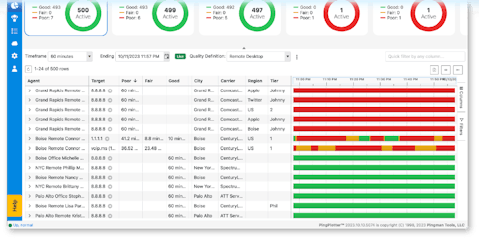
Everything shifts when you can show the issue across locations instead of describing it in isolation.
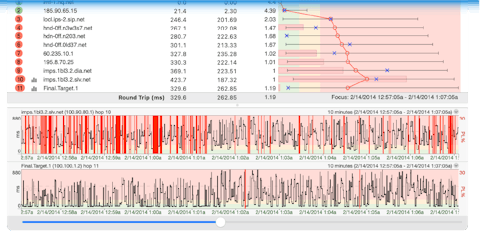
A timeline that reveals when latency began—across multiple remote endpoints—immediately adds clarity. A path visualization that shows where packet loss occurs pinpoints whether the issue lives in a home ISP, a backbone provider, or a SaaS platform.
Now the conversation changes: Instead of explaining, you’re demonstrating. Instead of defending, you’re guiding.
Visual, historical data answers questions before they’re asked:
- Is this widespread or isolated?
- Has this happened before?
- Is it getting better or worse?
Just as importantly, it clarifies ownership. When the data shows the issue exists outside your network, the narrative shifts. IT is no longer the source of the problem: it becomes the translator of it.
That distinction matters.
Visibility isn’t about tools, it’s about trust
It’s easy to think of visibility as a tooling problem. More dashboards. More alerts. More data.
But in distributed environments, visibility is really about confidence across complexity. When IT consistently explains issues clearly—across users, locations, and providers—trust builds. Leadership stops asking the same reactive questions. Escalations become more focused and less emotional.
Instead of reacting to scattered complaints, IT can connect the dots:
- This issue affects remote users on a specific ISP
- It began at a defined time
- It is outside internal infrastructure
- It is being actively monitored
That level of clarity changes the tone entirely. With real visibility, IT leads. Without it, IT defends.
If you don’t control the narrative, someone else will
Network issues are inevitable—especially in distributed environments where you don’t control every connection point. But what’s avoidable is losing trust because the story wasn’t clear.
When remote users report problems and leadership hears inconsistent explanations, they create their own narrative. And it often points inward. Visibility changes that.
It allows IT to explain not just what’s happening, but where it’s happening, who owns it, and what happens next. It replaces uncertainty with direction.
When you can clearly map the problem across a distributed network, leadership doesn’t question your competence.
They rely on it.
Turn network complexity into clarity
When network issues span home networks, ISPs, and cloud providers, vague updates aren’t enough—you need proof across every hop.
With PingPlotter Cloud, you can visualize latency, packet loss, and performance from distributed endpoints in real time, so leadership sees exactly what’s happening, where it lives, and who owns it.
Start turning network complexity into clarity—and credibility.
Talk to a Product Specialist Explore PingPlotter Cloud